


How-to
Tarot for Beginners: Your First Three-Card Spread
A first tarot reading needn't involve memorising a whole deck. Start with three cards, a useful question and a few minutes to notice what connects them.

Tarot for beginners starts with a question and a simple three-card spread: shuffle, draw three cards, then read them from left to right as past, present and what to consider next. You do not need to memorise every card before your first reading. This guide takes you from opening a deck to making sense of what you see, with reflection rather than fortune-telling as the point.
A quiet table and somewhere to jot down a thought are plenty. No elaborate ceremony required, unless clearing the dining table counts.
Get to know the deck in two minutes
A standard tarot deck has 78 cards: 22 Major Arcana and 56 Minor Arcana in four suits, usually Wands, Cups, Swords and Pentacles. The Major Arcana show broad themes and familiar figures, while the Minor Arcana give you smaller scenes to think about. Each suit offers another way into the question: Wands often point towards action, Cups towards feelings, Swords towards thoughts and Pentacles towards practical matters.
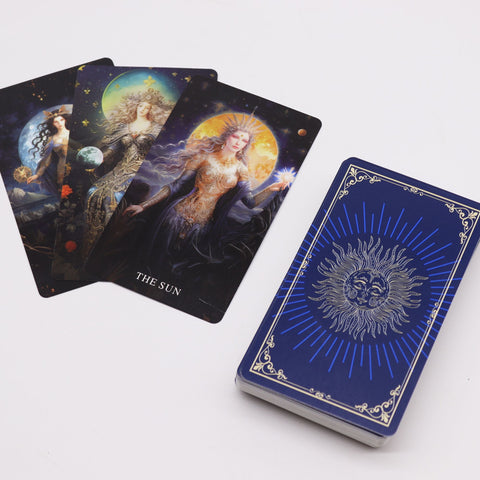
For a first deck, choose artwork you can bear to look at closely and a guidebook you can refer to. The Requiem Arcana tarot deck has 78 cards with skeletal artwork by Vera Petruk and includes a guidebook explaining each card. If that feels a bit sombre for your table, the Goddess Arcana tarot deck reinterprets classic tarot figures through goddess-inspired artwork and also comes with a guidebook. The Gold Foil Tarot Set with Book pairs a black and gold 78-card deck with a full-colour guidebook.
The guidebook is a reference, not an exam paper. Start by looking at the picture before you look up the meaning. If you are still choosing between deck types, our tarot vs oracle cards guide explains why a tarot spread and an oracle draw are not quite the same thing.
Ask a question you can actually reflect on
A useful tarot question gives you room to think about your choices. Try "What am I bringing into this situation?" or "What might I need to pay attention to?" rather than asking a card to announce what another person will do. You can keep it broad for a first reading: "What should I reflect on as I start something new?" works without requiring a detailed backstory.
Once you have your question, write it down. That gives you something to return to if a striking illustration sends your thoughts off on a tangent. Tarot pictures are quite capable of making you forget why you sat down.
Shuffle in whatever way lets you handle the cards comfortably. You can mix them in your hands or spread them face down on the table and move them around. Stop when you are ready, draw three and place them face down from left to right. There is no required shuffle count, and you do not need to shuffle like someone dealing poker on television.
How to do a three-card tarot spread
A three-card spread gives each card a job, so you have a way to begin without trying to interpret the whole deck at once. For this version, the positions are past, present and what to consider next. That last position is a prompt for reflection, not a forecast.
- Set your question in front of you. Keep the wording visible in a notebook or on a piece of paper.
- Lay out three cards. Put the first on the left, the second in the middle and the third on the right. Turn them over one at a time in that order.
- Read the past card. Ask what background, earlier choice or pattern might matter to your question. You do not have to make the picture fit a particular event.
- Read the present card. Notice what feels relevant now. What is happening in the picture, and which detail catches your eye first?
- Read the final card. Ask what you might consider next. It could point to an attitude to examine or a practical question to take away.
- Look across all three. Note one connection or contrast, then write a sentence about what the spread helped you notice.
Tip: Some guides call the final position "future". You can use that label if you like, but read it as a direction to consider, not an event the cards have promised.
How to read a tarot spread as a story
To interpret a spread, start with what is on the cards, then ask how the pictures and traditional meanings change from one position to the next. Look for repeated colours, figures facing towards or away from each other, or a shift from busy scenes to still ones. After that, check your guidebook for meanings you may have missed.
Suppose a card traditionally linked with rushing into action appears in the past position, while the present card draws your attention to a difficult conversation. You might ask whether you have been moving too quickly to hear someone properly. That is a question you can test against your experience, not a verdict from the deck.
The Knight of Swords gives a concrete example of how images and meanings meet. It is a Minor Arcana court card traditionally associated with swift action, ambition and directness; it is also the design printed on the I am Brave Knight of Swords tote bag. In a reading, "directness" might sound useful in one position and worth questioning in another. Where the card lands matters.
If a guidebook meaning does not seem to connect, write down both the meaning and your first impression. You can leave the question open. A reading does not need a neat moral at the end.
Do you need to read reversed cards?
No. A reversed card is one that appears upside down, and reading it differently is optional. Some readers give reversals a separate interpretation; others turn every card upright and work with the position, image and question instead.
For your first spread, choose one approach before you shuffle. Turning reversed cards upright keeps the task smaller. If you later decide to use reversals, consult your deck's guidebook and see which interpretations you find useful. There is no extra credit for making your first reading harder.
When the spread makes no sense
An unclear spread is a reason to slow down, not to keep drawing until you get an answer you prefer. The question may be too vague, or you may be asking the cards to settle something they cannot settle.
All three cards seem unrelated
Go back to your written question and take the cards one position at a time. Describe each image in plain words before looking for a shared theme. A contrast between cards can be a connection too.
The guidebook meaning does not fit
Leave it in your notes and look at the illustration again. Traditional interpretations give you possibilities, not a compulsory answer. If nothing clicks, put the cards away and revisit your notes later.
You keep drawing extra cards
Stop at three for now. Write down what remains unclear and try wording a more focused question another time. More cards can give you more to untangle, rather than more certainty.
Looking after your tarot deck
Put the cards back in their box after a reading and keep them somewhere dry, away from spills and direct sunlight. If you want to remember what you drew, record the question, the three cards and a couple of lines about your interpretation. You may find a later reading of those notes more interesting than the first.
There is no need for a special cloth or storage ritual to begin. Give yourself enough space to lay out three cards without nudging your tea across them. That is the practical standard.
Tarot for beginners FAQs
Can I read tarot cards for myself?
Yes. Start with a question about your own perspective or choices, then write down what you notice in the three cards. You can reconsider your interpretation later.
Do I have to learn all 78 card meanings first?
No. Begin with the pictures and the positions, then use a guidebook to check traditional meanings. Familiarity comes from handling the cards, not memorising a list before you start.
Can I use playing cards for this spread?
You can lay out three playing cards and use the positions as reflection prompts, but that will not be a standard tarot reading. A standard tarot deck includes Major Arcana as well as its four Minor Arcana suits.
What to remember
Pick one question, draw three cards and write down what you notice before reaching for the guidebook. You can build your knowledge one reading at a time. If you are choosing a deck, browse our tarot, oracle and playing cards collection and look for artwork you want to spend time with.


