



How-to
Where to Hang Wind Chimes (and How to Choose the Sound)
Find a spot with a breeze, choose a sound you want to hear often, and give your wind chime room to move without bothering the neighbours.

Wondering where to hang wind chimes? Choose a sheltered spot that catches a light breeze, with space for the chime to move without hitting a wall, window or plant. Avoid a bedroom window if you want quiet at night, and test the sound from inside your home before fixing anything in place. The right spot depends as much on what you hear as on what you see.
A porch, balcony or garden branch can all work. A windy corner may seem promising until you hear the same five notes through an open window all afternoon. Here is how to choose the sound first, find a spot for it, and hang it securely.
Choose the sound before you choose the spot
Wind chimes sound different because their moving parts strike different materials. Bamboo tubes tend to make a hollow knock; shell pieces clink together; small brass bells ring. None is the right sound for every garden. Think about what you would want to hear while washing up with the kitchen window open, not just what sounds pleasant for ten seconds in your hand.
For a soft, woody sound, the Bamboo Wind Chime, Natural Finish, 6 Medium Tubes is made from bamboo and suits indoor or outdoor spaces. Its medium tubes make it a sensible place to start if you are unsure how much sound you want. The Bamboo Wind Chime, Natural Finish, 6 Large Tubes has six large bamboo tubes and can hang in a garden, porch or hallway. Choose between them by the space you have and the tone you prefer, rather than assuming that a larger tube automatically means a louder chime.
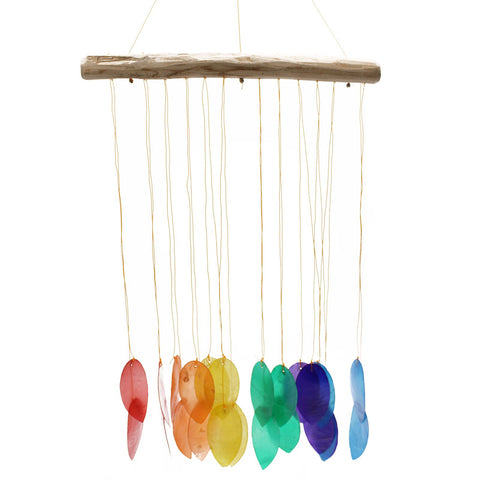
Shell has a lighter, busier sound. On the Rainbow Large Leaf Driftwood Chime, Capiz shell pieces clink as they move against one another; the chime combines those rainbow-coloured pieces with driftwood. The Coconut and Capiz Wind Chime, Blue and White Stars, 30cm uses Capiz shell too, but its blue and white star design hangs at a more compact 30cm. Both suit indoor or outdoor use. They are good choices when you want to see the pieces move as well as hear them.
If you prefer a soft natural sound, the Coconut Leaf Wind Chimes, Whitewash is made from coconut leaf. Give it a breeze under cover, such as on a porch or balcony. For a distinct little ring rather than a knock or clink, the Indian Chimes Hamsa Mirror with Three Bells has three brass bells beneath a brass hamsa hand and small mirror. Bells are worth distinguishing from the long tubular chimes you might be picturing: listen for a tinkle, not a sequence of notes.
Where to hang wind chimes in a garden
In a garden, start with a spot that gets an occasional breeze but has some shelter from strong wind. A porch, sturdy branch or sheltered part of a patio gives a chime a chance to move without spending every gust tangled in the nearest shrub. Leave clearance beneath it and on every side. If its pieces keep striking a fence, you will hear the fence more than the chime.
Try the position before making it permanent. Hang the chime temporarily from a secure point on a breezy day, then step inside and listen from the rooms you actually use. Open and close the window. Walk towards the neighbour's side of the garden, if you can. A gentle sound beside a patio chair can be surprisingly insistent beside somebody else's bedroom.
For a small garden, one chime is plenty. Position it near the place you sit rather than at the far end simply because there is a convenient hook there. If you are deciding what else belongs in a tight outdoor space, our small garden and balcony ideas start with making room for the things you will notice and use.
Where to hang wind chimes on a balcony or indoors
On a balcony, choose a covered position where the chime stays within your own space as it swings. Check the building's rules before attaching anything to a ceiling, railing or wall, and consider the flat above and below yours. A chime beside the door lets you hear it when you step out; one fixed close to a shared wall may make its presence known rather more widely.
Indoors, a hallway near an opening door can give a chime occasional movement. A still room will not produce much sound on its own, which is fine if you mainly like how it looks. The six-large-tube bamboo chime suits a hallway as well as an outdoor spot; the shell designs can hang indoors too. Give any indoor chime enough room that opening a door cannot catch it.
What about the bedroom window? If you like a chime there, try it during the day first and listen with the window both open and shut. Remember that an outdoor chime may sound more noticeable when the house is quiet. Moving it a little further from the window is often easier than trying to persuade the wind to keep office hours.
Tip: A spot that looks sheltered from the ground may still catch a strong gust around a building corner. Watch how the chime moves on more than one breezy day before settling on its final position.
How to hang a wind chime securely
Use a fixing suited to the surface and the chime's weight, then leave enough space for the longest hanging part to swing freely. A sturdy branch needs a secure attachment that will not slip towards its tip. A wall or ceiling hook needs to be installed for the material it goes into; a decorative hook with a flimsy fixing is not the place to gamble.
- Measure the hanging space. Check the full drop of the chime, then allow extra clearance below and around it for movement.
- Choose the fixing. Use appropriate hardware for timber, masonry or another mounting surface. If you rent, ask before drilling.
- Attach and check. Hang the chime from its intended hanging point. Give the fixing a gentle check and make sure nothing catches when the chime swings.
- Listen again. Stand inside, outside and near the boundary. If the sound carries further than expected, move it to a more sheltered spot.
Do not tie a chime to a thin plant stem just because it happens to be at the right height. Plants grow, bend and move; your hanging point needs to hold steady while the chime moves beneath it.
Care and weather basics
Bring outdoor chimes in ahead of storms or strong winds, particularly designs with delicate shell pieces. Check their hanging cords and fixings now and then, especially after windy weather, and take them down if anything is fraying or loose. A covered spot helps shelter a chime, but it does not make it storm-proof.
If pieces become tangled, take the chime down and separate them gently rather than pulling while it hangs. Let a wet chime dry before putting it away. Store it where its strings can lie without being knotted around the pieces; a careful minute now saves an awkward one when the first warm day arrives.
Wind chime FAQs
What do wind chimes mean?
Wind chimes have different meanings in different traditions. Some people hang them simply for their sound; others use them as decoration or as a reminder of someone. The hamsa hand, for example, is traditionally associated with protection and good fortune, but a chime does not need a symbolic meaning to earn its place by the door.
Where should wind chimes go for feng shui?
In feng shui traditions, placement can depend on the material of the chime and the particular approach being followed, so there is no single correct place for every home. If you are following a specific school, use its guidance; otherwise, start with a position where the chime can move freely and its sound is welcome.
Can wind chimes hang indoors without a breeze?
Yes, but they may stay quiet in a still room. Hang one near a doorway or an open window if you want occasional movement, keeping it clear of the door and frame.
Are wind chimes too noisy for neighbours?
They can be, especially in a windy spot or close to a neighbour's window. Listen from different parts of your home and garden, then move the chime further in or under cover if it carries more than you expected.
The short version
Pick the sound you would enjoy hearing repeatedly, then find it a lightly breezy spot with room to move. Test it before fixing it permanently, and bring it in when the weather turns rough. If a woody knock sounds right for your space, explore our bamboo wind chimes.


