


How-to
Chakra Colours Explained: The Seven From Root to Crown
A plain-English guide to the seven chakra colours, their names and locations, and what those rainbow bands mean on a bracelet or stone.

Chakra colours in the familiar seven-chakra chart run from red at the root to violet or white at the crown. Each colour marks a different point along the body, but the rainbow sequence is a modern way of presenting a much older tradition. Here are the names, locations and colours in one place, followed by how to read them on jewellery, candles and stones.
You do not need to memorise Sanskrit to understand a bracelet in seven colours. It helps, though, to know what the colours are meant to represent and why one maker's choice of stones might surprise you.
Where do the chakra colours come from?
Chakras come from Indian tantric and yogic traditions; the familiar seven-colour chart is a later Western adaptation. Traditional systems have varied, so a tidy rainbow diagram should not be mistaken for the single original version. It is a useful visual shorthand, particularly when you are looking at contemporary jewellery or décor, but it cannot tell the whole history.
In the common chart, the chakras are arranged from the base of the spine upwards. Each has a Sanskrit name and an associated colour. Think of the sequence as a way to recognise the symbols on an object, rather than a test you have to pass before you can wear it. Most people meet the chart on a necklace, not in a Sanskrit text.
What are the seven chakra colours?
The usual sequence is red, orange, yellow, green, blue, indigo, then violet or white. The locations below show where each chakra is placed in the common seven-chakra chart; they are part of that tradition, not physical structures you can find on a scan.
| Chakra | Sanskrit name | Location | Colour |
|---|---|---|---|
| Root | Muladhara | Base of the spine | Red |
| Sacral | Svadhishthana | Lower belly, below the navel | Orange |
| Solar plexus | Manipura | Upper belly | Yellow |
| Heart | Anahata | Centre of the chest | Green |
| Throat | Vishuddha | Throat | Blue |
| Third eye | Ajna | Forehead, between the eyebrows | Indigo |
| Crown | Sahasrara | Top of the head | Violet or white |
If you are trying to remember the order, start at the bottom with red and move upwards through the rainbow. The crown is the one with two common colour options. You may also see pink used for the heart in modern designs, alongside or instead of green; that does not mean the maker has put the heart in the wrong place.
How do the colours work on jewellery and candles?
On a single-chakra piece, the name tells you which part of the chart inspired it. The colour and any chosen stones may follow that association, but they do not have to match the chart like paint samples. A stone's traditional meaning, its appearance and the design all play a part.
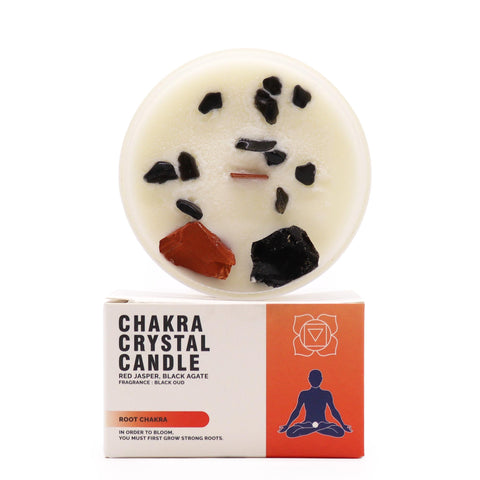
Take the Root Chakra Crystal Candle with Red Jasper & Black Agate. It uses soy wax in glass, with red jasper and black agate, and has a Black Oud fragrance. In the chakra tradition, the root is associated with grounding and stability. That association explains the name; it is not a promise about what lighting the candle will do.
Jewellery makes the distinction easier to spot. The Cedarwood Solar Plexus Chakra Bangle with Citrine centres citrine among cedarwood beads with a warm, woody aroma. In crystal lore, citrine is linked with confidence and abundance, while the solar plexus belongs to the yellow part of the chart. You can like the wood, the stone or the symbolism. All are reasonable reasons to wear it.
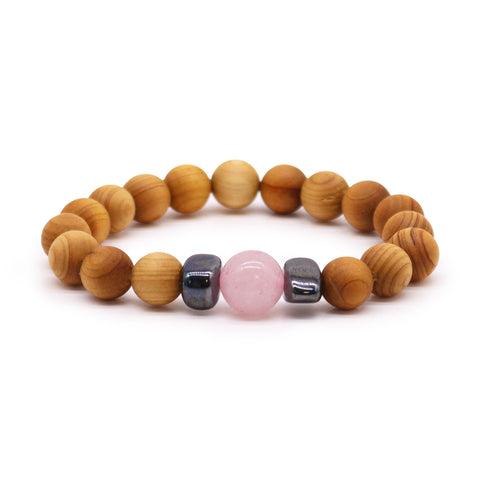
The heart is usually green on a chakra chart, yet the Cedarwood Heart Chakra Bangle with Rose Quartz has a rose quartz centrepiece. Rose quartz is traditionally associated with love and compassion, which explains its heart-chakra link. Likewise, the Cedarwood Throat Chakra Bangle with Sodalite uses a stone traditionally associated with communication. Its cedarwood beads share that same woody aroma. These are choices about traditional associations, not strict colour-coding rules.
How can you use chakra colours in a room?
Use the palette as a design prompt rather than trying to fit seven bright colours onto one shelf. Choose a spot with natural light, leave some space around the objects and decide whether you want the full sequence or one colour you already enjoy. The seven-colour approach suits a small display; a single colour is easier to live with across a whole room.
The Hanging Chakra Stone Pendant, Hansa brings coloured gemstones into a window or beside a mirror. Its Hansa design is handmade in India. Hang it where you can see the stones in the light, then let the rest of the shelf stay quiet. Seven colours do enough talking on their own.
There is a free version, too: arrange books, fabric or objects you already own from warmer colours to cooler ones. Or pick one shade from the chart for a notebook beside your chair. If you are setting aside a place to sit and reflect, our guide to making a meditation corner at home starts with the space you have, rather than a shopping list. You can use chakra colours as a visual focus without expecting anything particular to happen.
What does a seven-chakra stone set mean?
A seven-chakra set uses several colours or stones to refer to the whole chart, from root to crown, rather than one named chakra. Check how the piece is made before assuming that every coloured section is a separate loose crystal or that a banded piece is one naturally striped stone.
The Bonded Chakra Heart Stones, for example, are made from pieces of several stones bonded into a single heart. Seven differently coloured stones make the bands, with red at the base and violet at the top. You get one heart-shaped piece, not a box of seven individual stones. The specific minerals are not named, so colour alone cannot identify them.
A Chakra In Crystal Palmstone uses the same seven-colour idea in a smooth, flattened shape that sits in the hand. It is approximately 45mm across and is also made from several stones bonded into one piece. If you prefer picking up an object to looking at it on a shelf, that shape makes sense. If you want to learn about individual named minerals instead, start with our guide to crystal meanings for beginners.
Tip: When a piece shows all seven colours, read the bands as a symbol of the full chart. To know exactly which minerals you are getting, look for their names rather than relying on colour.
Chakra colour FAQs
Is the heart chakra green or pink?
Green is the heart colour in the common seven-chakra chart. Pink also appears in modern heart-chakra designs, especially with rose quartz, which is traditionally associated with love and compassion.
Is the crown chakra purple or white?
Both appear on common charts. Violet is often used to complete the rainbow sequence, while white is another familiar choice for the crown.
Do chakra crystals have to match their chakra colour?
No. Contemporary pieces may use stones chosen for their traditional associations rather than a precise colour match. A heart piece with rose quartz is an example.
Is a seven-chakra stone made of seven separate crystals?
Not necessarily. Some designs have separate beads or stones; a bonded chakra stone joins pieces of several stones into one object. Check the construction if that distinction matters to you.
What to remember
For the common chart, follow the colours upwards from red at the root to violet or white at the crown. On an object, the sequence is a reference to a tradition, not a guarantee that its stones match every colour or have any particular effect. If you like the whole banded sequence, our bonded chakra stones show how it looks in a single piece.


