


How-to
Crystal Meanings for Beginners: Ten Stones to Get to Know
A plain-English guide to ten familiar stones: what they are, what people traditionally associate with them, and how to pick your first.

Crystal meanings are traditional associations people give to stones, not things the stones are proven to do. Amethyst is linked with calm, rose quartz with love, and tiger's eye with confidence, but you can choose a stone simply because you like looking at it. Here are ten common names, what each stone actually is, and a sensible way to pick your first.
The geology and the symbolism are different conversations. Keeping them separate makes both more interesting.
Crystal meanings at a glance
Use this as a starting list, not a set of rules. Traditions vary, and the same stone can carry more than one meaning.
| Stone | What it is | Traditionally associated with |
|---|---|---|
| Amethyst | Purple quartz | Calm and clarity |
| Rose quartz | Pink quartz | Love and compassion |
| Clear quartz | Clear quartz | Clarity and intention |
| Tiger's eye | Banded quartz with a shifting sheen | Confidence and focus |
| Aventurine | Quartz grains with mica flecks | Luck and opportunity |
| Sodalite | A blue silicate mineral | Clear thinking |
| Carnelian | Orange to reddish chalcedony | Creativity and courage |
| Obsidian | Volcanic glass | Grounding and protection |
| Labradorite | A feldspar with flashes of colour | Change and intuition |
| Selenite | A form of gypsum | Clarity |
Start with the quartz family
Several familiar crystal names belong to quartz, but they look quite different once you put them side by side. Colour, pattern and finish are often easier to choose by than an abstract meaning.
Amethyst: purple quartz
Amethyst is a purple variety of quartz, traditionally associated with calm and clarity. People might keep one on a bedside table or hold it during a quiet few minutes, without expecting the stone to change how the night goes. The Medium African Chevron Amethyst tumble stone has naturally fused white quartz running through its purple in V-shaped stripes. Even a familiar stone need not be one solid colour.
Rose quartz: pink quartz
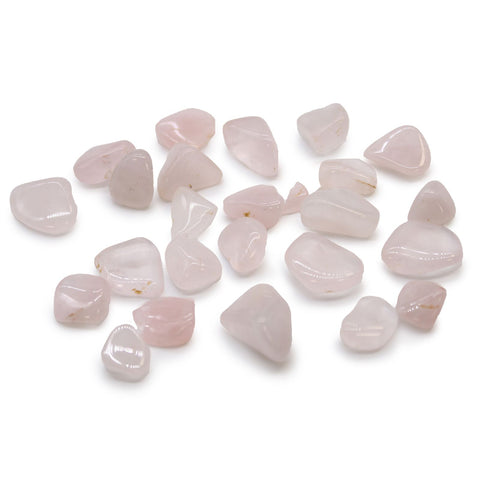
Rose quartz is pink quartz. Traditionally, it is associated with love and compassion. That can mean giving it to someone dear, or placing it beside a photograph that matters to you. The Small African Rose Quartz tumble stone varies from pale blush to a deeper pink. If you are choosing by colour online, expect the particular stone you receive to have its own shade.
Clear quartz: the see-through one
Clear quartz is quartz that looks transparent or nearly so. In crystal traditions it is associated with clarity and intention, which is why people sometimes use it as a prompt while writing a thought down. It need not be flawless to be interesting: cloudy areas and internal lines give you something to inspect when you turn a piece in the light.
Tiger's eye: the moving band of light
Tiger's eye is banded quartz known for chatoyancy, the bright band that appears to move as you tilt it. Traditionally it is associated with confidence and focus; some people keep a piece on a desk as a visual cue before starting a task. The Large African Variegated Tiger's Eye tumble stone has golden-brown bands and that distinctive cat's-eye effect. Turn it towards a window and the reason for its name becomes fairly obvious.
Look beyond quartz
These three bring a different mix of colour and texture. If purple and pink are not your thing, there is no entrance exam to pass before picking green, blue or orange.
Aventurine: green with a little shimmer
Aventurine is made up of quartz grains and mica flecks rather than being a single mineral in its own right. The flecks catch the light, giving aventurine a subtle sparkle. It is traditionally associated with luck and opportunity, often kept as a pocket stone or added to a small display. The Small Aventurine tumble stone is an option if you want to see that texture up close. The association is a piece of symbolism, not a reason to let a pebble make your decisions.
Sodalite: blue with white markings
Sodalite is a silicate mineral. Its blue colour, sometimes crossed by white veins, makes it easy to recognise among a handful of tumbled stones. Traditionally associated with mental clarity, it can sit beside a notebook as a reminder to pause and sort out what you want to say. The Medium African Pure Blue Sodalite tumble stone has shades of denim and royal blue with subtle white veining; the markings vary between pieces.
Carnelian: orange to reddish stone
Carnelian is a variety of chalcedony, often orange or reddish. In crystal traditions it is associated with creativity and courage. You might put it beside a sketchbook, not because it will supply the next idea, but because a small, bright object can mark the moment you sit down and begin. Choose by the colour that appeals to you, from softer orange to deeper red.
Three stones with very different structures
Not everything sold under the broad label of "crystals" has the same geology. That matters most when you want to understand what you are holding and how to look after it.
Obsidian: volcanic glass
Obsidian forms from volcanic material and is glass, rather than a crystal in the geological sense. In some crystal traditions it is associated with grounding and protection. A polished piece can be a striking dark contrast on a shelf; a raw edge may be sharp, so handle unfamiliar pieces with care. Its traditional meaning does not make it a protective device.
Labradorite: colour that appears as you move it
Labradorite is a feldspar known for labradorescence: flashes of colour that show up at certain angles. It is traditionally associated with change and intuition. If you are choosing one in person, tilt it rather than judging it from straight ahead. A stone that looks grey on the table can reveal its colour as soon as you pick it up.
Selenite: pale gypsum
Selenite is a form of gypsum, often chosen for its pale appearance. Traditionally it is associated with clarity and used in crystal-keeping rituals. It needs more careful handling than a sturdy quartz tumble stone, particularly around water. For the practical details, see our guide to looking after selenite and keeping it dry.
How do you choose your first crystal?
Pick one you like the look and feel of, then learn its name. A traditional meaning can give it a place in a personal ritual, but it does not have to be your reason for owning it. If you are buying online, look for a photograph that shows the colour and finish clearly, and allow for natural variation between stones.
Tumbled stones are smoothed and polished, so they are pleasant to turn in your hand and straightforward to carry. Raw pieces show more of a stone's natural shape and texture, though points and edges can be delicate or sharp. Neither is the more authentic choice. For a first try, we would start with a tumble stone and see which one you keep reaching for.
Tip: Put your first stone somewhere you will notice it, such as beside a book or on your desk. If you forget it is there for a month, you can move it. No elaborate arrangement required.
A way to meet lots of stones at once: our crystal a day set has about 25 mixed tumble stones, such as rose quartz, aventurine, tiger's eye and sodalite, a mango wood box carved with a sun and moon, and a printable finder for telling 24 common stones apart.
Crystal meanings FAQs
How do amethyst crystals work?
Amethyst is purple quartz; its traditional association with calm is a symbolic meaning, not a demonstrated effect. People use it as an object to hold, display or include in a personal ritual.
What is rose quartz crystal good for?
Rose quartz makes a pink pocket stone, display piece or thoughtful gift. In crystal traditions it is associated with love and compassion, but it cannot create either on someone's behalf.
How do you clear quartz crystal?
If you mean removing dust, use a soft cloth and check whether the piece has any delicate fittings first. If you mean a traditional cleansing ritual, there is no single required method; our guide to cleansing crystals and which stones to keep dry explains the options.
In short
Learn the stone, enjoy the colour, and hold its traditional meaning as an invitation to reflect rather than a promise. One piece is enough to begin. If a polished pocket stone sounds right, browse our tumbled stones and chip stones and choose the one you would be pleased to find on your desk.


