




How-to
Lucky Cat Meaning: Raised Paws, Colours and Where to Put One
Left paw or right? Here's what a lucky cat traditionally means, where people put one and what to check when a solar paw stops moving.

The lucky cat, or maneki-neko, is a Japanese beckoning cat: traditionally, a raised left paw invites people, while a raised right paw invites money or good fortune. Its colour, coin and position add to the symbolism, but none of them is a promise that anything will happen. Here is how to read one, choose a spot and keep a moving paw moving.
You may have seen one waving beside a shop till, in a restaurant window or on someone's shelf. The little paw can look like a farewell wave from across the room. It is meant as an invitation.
What does maneki-neko mean?
Maneki-neko means "beckoning cat" in Japanese. The figure comes from Japan and dates back to at least the 19th century, during the Edo period. You'll also see it called a lucky cat or money cat, and it is familiar in Chinese businesses too. That's why a collection or product name might say "Chinese cat" even though the figure's origin is Japanese.
There are different stories about how the cat became a symbol of welcome. In one well-known legend, a cat beckons a traveller towards a temple and away from a storm. It is a story, not a way to prove that any particular ornament will change your fortunes. If you enjoy the stories behind familiar symbols, our guide to lucky charms from around the world has more to read.
Left paw or right paw: which does what?
By tradition, the left paw beckons people or customers; the right paw beckons money or good fortune. Think of the cat by a café door inviting people in, and the one beside a till expressing a wish for prosperity. That's a useful way to remember the distinction, although you may hear other interpretations.
Check the cat itself rather than relying on its name or colour. The Very Gold Money Cat, for instance, has a moving left paw, despite "money" being in its name. It stands 15cm tall and keeps waving while powered by an AAA battery. There is no on/off switch, so removing the battery is how you stop it.
A moving paw and a fixed raised paw can carry the same traditional invitation. The motion is there because watching a small ornament repeatedly beckon is oddly absorbing, especially when the rest of the shelf is behaving itself.
Do lucky cat colours have different meanings?
Colour meanings vary between traditions and sellers, so treat them as associations rather than a strict code. Gold is commonly linked with wealth, white with purity and black with keeping misfortune away. You do not need to memorise a colour chart to choose one; the colour that works on your shelf is a sound reason too.
For a lighter look, the White Money Cat is 15cm tall and has a moving left paw. Like the gold version above, it takes an AAA battery, which is not included. If you'd rather have a darker ornament, the Black Money Cat is glossy black, the same height and also waves its left paw while powered.
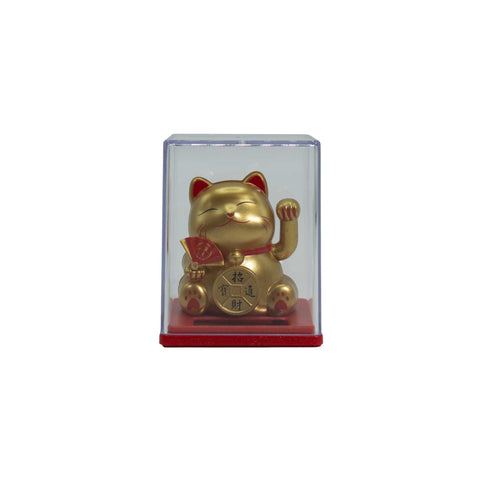
At approximately 7 x 5.5 x 5cm, the Mini Solar Powered Money Cat in Box, Gold has red detailing and a clear display box. Its paw moves when it catches natural or bright indoor light. Gold makes an obvious nod to the money-cat tradition; the small size makes it easier to give the cat a spot of its own without rearranging the entire room.
What is the coin on a lucky cat?
The coin often shown with a maneki-neko refers to money and prosperity. On traditional designs it may resemble a Japanese koban, an old oval coin. Some cats hold one, some have a coin-shaped panel on the front, and some have other painted motifs instead. The symbol matters more than matching every detail of one design.
A coin-shaped detail is not the same thing as a coin slot. If you want a cat that can actually hold your change, the Ceramic Money Cat Bank, Black on Cushion has a slot at the back. It is a black and white ceramic figure with red and gold detailing, seated on a patterned red cushion. Its raised paws are part of the ornament.
Where should a lucky cat face?
A common traditional spot is near an entrance, with the cat facing towards the door or the people coming in. In a shop, you may see one by the door or till; at home, an entrance table or a shelf with a view of the room makes sense. It is a way of expressing welcome, not a rule that requires you to measure the angle of the hallway.
Keep the practicalities ahead of the symbolism. Give it a stable surface where it will not be knocked as you put down keys or bags. A cat facing the entrance from a shelf is more useful as decoration than one balanced precariously on the door frame. If your best spot is a desk or living-room shelf instead, it can still be a small reminder of welcome.
A moving solar cat needs enough light as well as a view you like. A gloomy entrance may be a good symbolic location but a poor place for its paw to move. In that case, choose a brighter shelf or a cat with a fixed pose.
Why are so many lucky cats solar-powered?
Solar-powered cats use light to move the paw without a replaceable battery. A small panel powers the motion, so the paw may wave in daylight or bright indoor light and slow down when the spot gets dimmer. It does not mean the cat is faulty when it takes the evening off.
The Solar Money Cat Wooden Base, Gold Moving Hand has its panel built into the base. Its glossy gold figure sits on a natural-look wooden base, with a red cord collar and small bell, and needs no batteries. Put it somewhere bright enough for light to reach the base rather than hiding the panel behind other ornaments.
The solar paw has stopped waving
Move the cat into natural or bright indoor light and check that nothing is shading its panel. If it moves again in a brighter spot, light was the issue. A window shelf can be useful, provided the cat sits securely and the panel is not tucked into shadow.
The battery-powered paw will not stop
Check whether your model has a switch. The gold, black and white 15cm cats above do not: their paws move continuously while powered, so take out the battery when you want them still. A shelf ornament with a fixed raised paw is simpler if you would rather not think about switches or batteries at all.
Lucky cat FAQs
Are lucky cats Japanese or Chinese?
Maneki-neko originated in Japan and is also familiar in Chinese businesses. A product called a "Chinese lucky cat" may still use the Japanese beckoning-cat design.
Which lucky cat paw invites customers?
Traditionally, the raised left paw invites customers or other people. The raised right paw is associated with money or good fortune.
Does a lucky cat have to face the front door?
No. Facing an entrance is a common traditional choice, but you can place one on a stable shelf where you can see and enjoy it. For a solar cat, choose a position with enough light for the paw to move.
Will a solar lucky cat wave at night?
Usually not in a dark room. It needs natural or bright indoor light to power the paw, so movement depends on how much light reaches its panel.
Choosing yours
Start with the paw if its traditional meaning matters to you, then choose a colour and a spot that suit your home. For a moving cat, decide whether that spot has enough light for solar power or whether you would rather use a battery. Our lucky waving cat collection has both moving and fixed designs to look through.


