



Seasonal
UK Moon Calendar 2026 and 2027: Full Moon Dates, Names and Phases
Every full moon, new moon and quarter moon from October 2026 to December 2027 in UK time, with the traditional full moon names and a free printable 2027 calendar.

The next full moon is the Hunter's Moon on Monday 26 October 2026 at 04:12 GMT. After that come the Beaver Moon on Tuesday 24 November at 14:53 GMT and the Cold Moon on Christmas Eve at 01:28 GMT. The tables below run on to December 2027, so whenever you're reading this, the next full moon is simply the first date in the list that hasn't passed.
Updated 30 September 2026 with every phase to the end of 2027. The times are the US Naval Observatory's, read on 30 September 2026 and converted to UK time. We checked all 62 phase times against our own calculation: every one lands on the same UK date, and none is more than a minute apart. Below: full moons and their names, new and quarter moons, the phases explained and a free 2027 printable.
Full moon dates for 2026 and 2027 in UK time
There are 15 full moons between October 2026 and December 2027. How to read the tables: each time is the exact moment of the phase, in GMT or BST depending on the clocks that day. You don't need to catch it. A full moon rises around sunset and looks full for a night or so either side, so the nearest clear evening will do, and nobody needs to be up at 04:12.
| Date | UK time | Full moon |
|---|---|---|
| Mon 26 Oct 2026 | 04:12 GMT | Hunter's Moon |
| Tue 24 Nov 2026 | 14:53 GMT | Beaver Moon (supermoon) |
| Thu 24 Dec 2026 | 01:28 GMT | Cold Moon (supermoon, closest of 2026) |
| Fri 22 Jan 2027 | 12:17 GMT | Wolf Moon (supermoon, closest of 2027) |
| Sat 20 Feb 2027 | 23:23 GMT | Snow Moon (supermoon) |
| Mon 22 Mar 2027 | 10:44 GMT | Worm Moon |
| Tue 20 Apr 2027 | 23:27 BST | Pink Moon |
| Thu 20 May 2027 | 11:59 BST | Flower Moon (seasonal blue moon) |
| Sat 19 Jun 2027 | 01:44 BST | Strawberry Moon |
| Sun 18 Jul 2027 | 16:45 BST | Buck Moon |
| Tue 17 Aug 2027 | 08:29 BST | Sturgeon Moon |
| Thu 16 Sep 2027 | 00:03 BST | Harvest Moon |
| Fri 15 Oct 2027 | 14:47 BST | Hunter's Moon |
| Sun 14 Nov 2027 | 03:26 GMT | Beaver Moon |
| Mon 13 Dec 2027 | 16:09 GMT | Cold Moon |
The clocks go back at 02:00 on Sunday 25 October 2026, the day before the Hunter's Moon, which is why its time is in GMT.
New moon dates for 2026 and 2027
A new moon is when the moon passes roughly between Earth and the Sun, so its sunlit side faces away from us and you can't see it at all. New moons fall about two weeks either side of each full moon.
| Date | UK time |
|---|---|
| Sat 10 Oct 2026 | 16:50 BST |
| Mon 9 Nov 2026 | 07:02 GMT |
| Wed 9 Dec 2026 | 00:52 GMT |
| Thu 7 Jan 2027 | 20:24 GMT |
| Sat 6 Feb 2027 | 15:56 GMT |
| Mon 8 Mar 2027 | 09:29 GMT |
| Wed 7 Apr 2027 | 00:51 BST |
| Thu 6 May 2027 | 11:58 BST |
| Fri 4 Jun 2027 | 20:40 BST |
| Sun 4 Jul 2027 | 04:02 BST |
| Mon 2 Aug 2027 (partial solar eclipse) | 11:05 BST |
| Tue 31 Aug 2027 (second in August) | 18:41 BST |
| Thu 30 Sep 2027 | 03:36 BST |
| Fri 29 Oct 2027 | 14:36 BST |
| Sun 28 Nov 2027 | 03:24 GMT |
| Mon 27 Dec 2027 | 20:12 GMT |
August 2027 brings two new moons worth knowing about. On Monday 2 August 2027 the moon crosses the face of the Sun: a total eclipse in parts of southern Spain and North Africa, and a partial one from the whole of the UK between about 09:00 and 11:00 BST. At around 10:00, roughly 42% of the Sun is covered from London, 46% from Plymouth and 27% from Edinburgh. Then on 31 August a second new moon arrives in the same month, which some calendars call a black moon.
First and last quarter moons
At first quarter the right-hand half of the moon is lit, as seen from the UK; at last quarter, it's the left. The name refers to the moon being a quarter or three quarters of the way through its cycle, not to how much of it you can see.
| First quarter | Last quarter |
|---|---|
| 18 Oct 2026, 17:12 BST | 1 Nov 2026, 20:28 GMT |
| 17 Nov 2026, 11:48 GMT | 1 Dec 2026, 06:08 GMT |
| 17 Dec 2026, 05:42 GMT | 30 Dec 2026, 18:59 GMT |
| 15 Jan 2027, 20:34 GMT | 29 Jan 2027, 10:55 GMT |
| 14 Feb 2027, 07:58 GMT | 28 Feb 2027, 05:16 GMT |
| 15 Mar 2027, 16:25 GMT | 30 Mar 2027, 01:54 BST |
| 13 Apr 2027, 23:56 BST | 28 Apr 2027, 21:18 BST |
| 13 May 2027, 05:44 BST | 28 May 2027, 14:58 BST |
| 11 Jun 2027, 11:56 BST | 27 Jun 2027, 05:54 BST |
| 10 Jul 2027, 19:39 BST | 26 Jul 2027, 17:55 BST |
| 9 Aug 2027, 05:54 BST | 25 Aug 2027, 03:27 BST |
| 7 Sep 2027, 19:31 BST | 23 Sep 2027, 11:20 BST |
| 7 Oct 2027, 12:47 BST | 22 Oct 2027, 18:29 BST |
| 6 Nov 2027, 08:00 GMT | 21 Nov 2027, 00:48 GMT |
| 6 Dec 2027, 05:22 GMT | 20 Dec 2027, 09:11 GMT |
What are the phases of the moon?
The phases are the changing shapes of the moon's sunlit side as it circles Earth, once every 29.5 days or so. The Sun always lights half of the moon; what changes is how much of that half faces us. In order, the eight phases are:
- New moon: the lit side faces away, so there's nothing to see.
- Waxing crescent: a thin sliver on the right, low in the west after sunset.
- First quarter: the right half is lit.
- Waxing gibbous: more than half lit and still growing.
- Full moon: the whole face is lit, rising around sunset and setting around sunrise.
- Waning gibbous: still mostly lit, with the shadow creeping in from the right.
- Last quarter: the left half is lit.
- Waning crescent: a sliver on the left, in the east before dawn.
The tables give the four exact moments; the other four phases are the days in between. A quick check from a UK garden: if the lit edge curves like a D, the moon is growing. Like a C, it's shrinking.
Where do full moon names come from?
Most of the full moon names used in the UK come from North American almanacs, which gathered Native American and early colonial names for each month's moon and made them popular. They're a tradition rather than an official list. A Pink Moon, for instance, won't turn pink. It would be handy if the sky offered that kind of labelling, but you have to bring your own calendar.
Two names follow the seasons instead of the calendar. The Harvest Moon is the full moon nearest the autumn equinox, and the Hunter's Moon is the one after it. In 2026 the Harvest Moon fell on 26 September, which makes October's full moon the Hunter's Moon; in 2027 the Harvest Moon is on 16 September.
Supermoons, blue moons and other questions
Which full moons are supermoons in 2026 and 2027?
Four in a row: 24 November 2026, 24 December 2026, 22 January 2027 and 20 February 2027. A supermoon is a full moon within 90% of the moon's closest approach to Earth in that orbit, the usual definition. It can look slightly larger and brighter than average, though that's hard to see by eye. The Christmas Eve Cold Moon is the closest full moon of 2026, about 356,700 km away, and the Wolf Moon on 22 January is the closest of 2027.
Is there a blue moon in 2027?
Yes, a seasonal one. The Flower Moon on 20 May 2027 is the third of four full moons between the March equinox and the June solstice, which is the older, almanac meaning of a blue moon. The better-known kind, a second full moon in one calendar month, doesn't come round again until 31 December 2028.
Why does another calendar show a different date?
It's usually set to Universal Time or US time rather than UK time. The Harvest Moon is at 23:03 UT on 15 September 2027, which is 00:03 BST on 16 September here, so plenty of calendars list it a day earlier. A one-minute difference is just rounding.
Simple ways to mark a full moon
You don't need a garden, a ritual or even a clear sky. One habit that sticks: after each full moon, write down one thing that has changed outside since the last one, such as a tree coming into leaf or the first evening you left the coat at home. After a year, you have a small record of the seasons where you live.
If you'd like to try moon water, our guide to making moon water covers the jar, the windowsill and which crystals to keep out of it. At the new moon, some people set a few intentions for the month ahead instead. The Hunter's Moon also falls in the run-up to Halloween, so if you mark Samhain, our Samhain altar ideas sit well alongside it.
Free printable: the 2027 moon calendar
The whole of 2027 on one A4 page: every full and new moon in UK time, the traditional names, the supermoons, the blue moon and the eclipse, with space each month to note what you saw. It prints clearly in black and white, and there's no email or sign-up to get it. Download the 2027 moon calendar (PDF)
For new guides like this one, there's an optional sign-up in the footer; the calendar is free either way.
Safety basics
Put candles and incense on a heat-resistant surface, away from curtains and anything else that can catch light, and never leave them burning unattended or within reach of children and pets. During the eclipse on 2 August 2027, never look at the Sun directly, even partly covered. Use certified eclipse glasses or a pinhole projector, and never point binoculars, a camera or a telescope at it without a proper solar filter.
Where to start
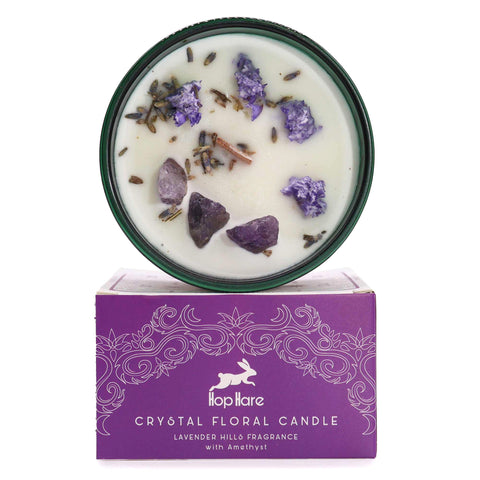
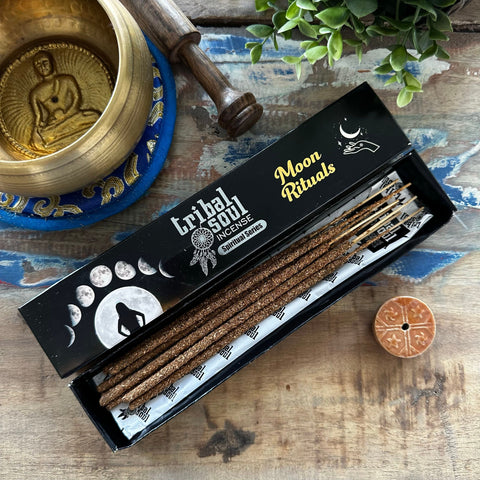
Pick the next date in the table and put it in your diary. A notebook by the window helps the habit stick: the Leather Moon Phases Notebook has about 100 deckle-edge pages and a clasp, so a page per full moon would last years. For the evening itself, the Hop Hare Moon crystal candle is soy wax set with amethyst and dried lavender, with The Moon tarot card hidden in its box (in tarot, The Moon is traditionally associated with intuition and dreams). The Moon Ritual incense sticks come with a ceramic holder.
For a windowsill, the Selenite Moon Bowl is a 10cm dish of a stone named after selēnē, the Greek word for the moon; keep it dry, as selenite should never go in water. The Brass Moon Phases Chimes are 43 x 40cm of brass moons and glass beads, with bells that ring in a breeze. There's more in our crystal and tarot candles.


